Ava Faint
Learning Focus for Term 1: History, Civics and Citizenship
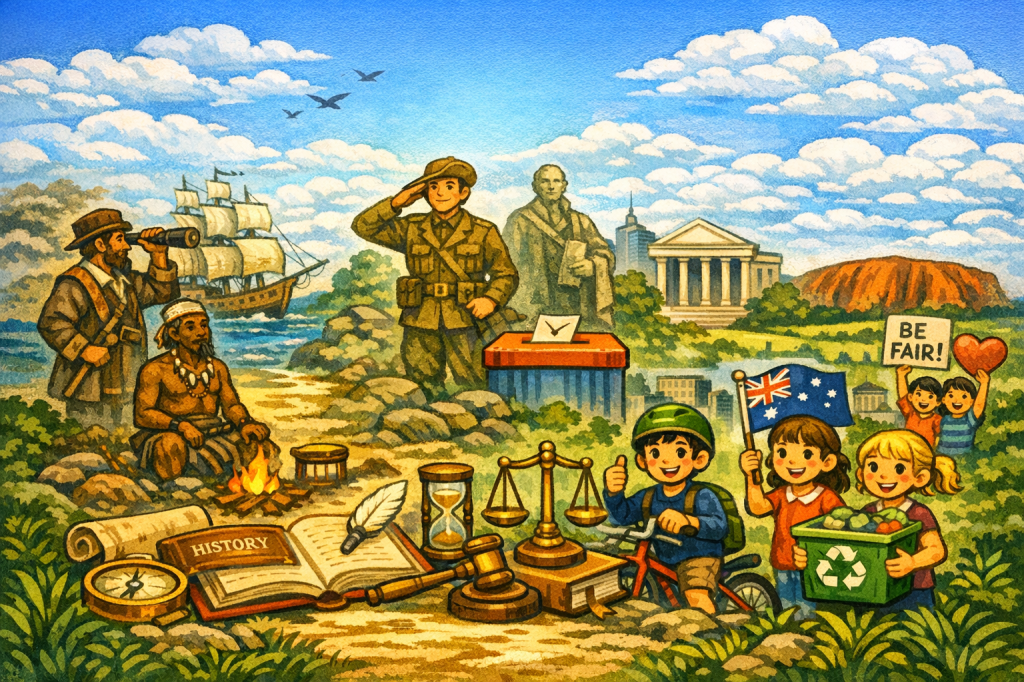
Hi parents and carers,
Welcome to year 4 HASS! For those who may be new to the subject HASS stands for Humanities and Social Sciences, which for year 4 includes History, Geography, and Civics and Citizenship. This term students will begin their learning journey through our unit Communities Through Time: How People Shape Our World. They will be exploring key areas of Australia’s history and how communities operate today. They are learning how people, cultures, and decisions impact the world they inhabit in and how they can contribute to a just and respectful community (ACARA, 2026).
History
Our history learning places a strong emphasis on the histories and cultures of Aboriginal and Torres Strait Islander people, students will be starting by investigating early expeditions and first contacts. Their learning will be guided by curriculum descriptors AC9HS4K02 and AC9HS4K04, as referred to in the below images (ACARA, 2026). These areas can often be described as sensitive and controversial; however, we will maintain an age-appropriate and respectful approach while teaching these topics.
Civics and Citizenship
Students will explore early encounters between Indigenous communities and European explorers, examining how these interactions influenced both groups. Texts such as Young Dark Emu highlight the complexity of Aboriginal land management and challenge common misconceptions (Pascoe, 2019). One of our assessments will have our students comparing a European explorer’s diary entry with an Aboriginal oral text describing the same event. This helps them understand how different perspectives shape historical interpretation (Reynolds, 2021).
How Students Will Learn
Students’ learning will be supported by a variety of teaching techniques, such as:
- Analysing historical materials including timelines, artifacts, maps, and artwork
- Participating in a simulated local council sessions or community decision-making
- Conversations in class around responsibility, rules, and justice
- Collaborative projects that study stories and local history
These approaches assist students in developing critical thinking skills, empathy, and a feeling of self and belonging.
Supporting Learning at Home
You might like to:
- Visit local museums or historical sites.
- Describe your own cultural background or family history.
- Talk about the importance of community rules.
- Discuss kindness, accountability, and justice in daily life.
- Watch films or read books about early Australian history.
Thank you for your ongoing support. Please reach out if you have any questions, we look forward to sharing more of your child’s learning throughout the term.
Learning Focus for Term 2: Sustainability and Active Citizenship
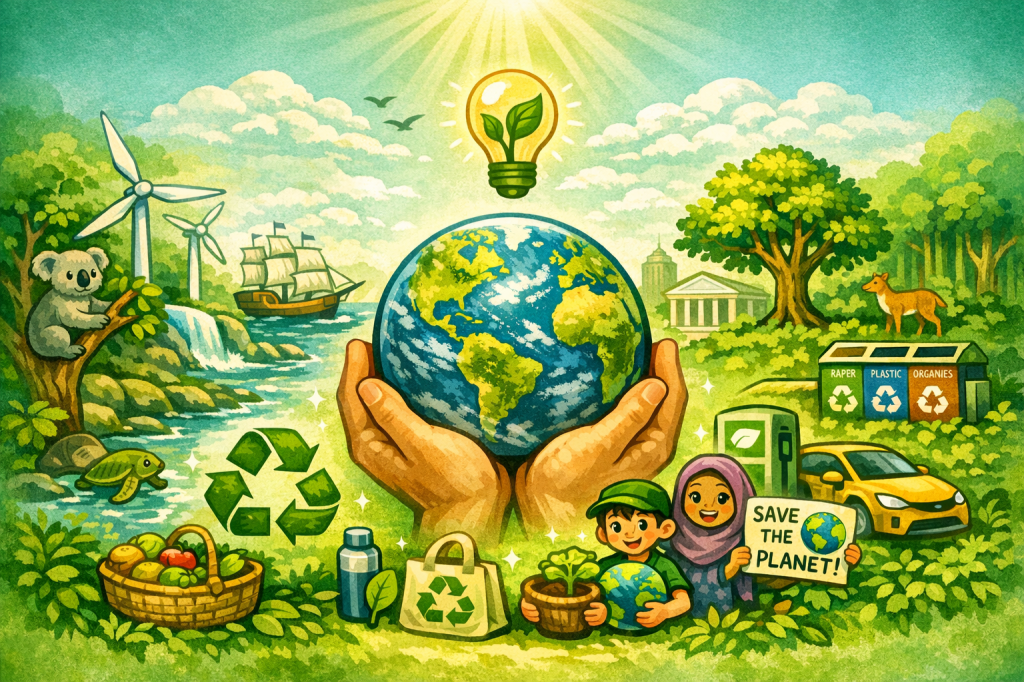
(AI Generated Image)
Greetings, parents, and carers
Welcome to Term 2! After a fantastic term studying civics and history, we[GU1] are excited to start a new educational journey with our second unit “Our World, Our Responsibility.” This term students are concentrating on how we can take care of the environment and how young people can make a positive difference. Sustainability and Civics and Citizenship work closely together in this unit to help students understand their role as active, responsible citizens (ACARA, 2026).
These lessons help students in making thoughtful choices, addressing common issues, and making positive contributions to their school community. It promotes creativity, responsibility, and understanding of the impact of one’s actions on others. In order to become engaged, knowledgeable learners, students investigate sustainability through actual school-related problems and create straightforward action plans that take social, economic, and environmental aspects into account.
What Students Are Learning and Why they are Learning it
This term, the cross-curricular priority of Sustainability supports our civics and citizenship education, which is still a crucial component of HASS. Students will investigate how people interact with their surroundings, how human activity affects ecosystems, and how communities might cooperate to take care of places (ACARA, 2026).
Sustainability
- Taking care of environments and locations
- Recognizing how humans affect ecosystems
- Investigating eco-friendly methods at home and in schools
Civics and Citizenship
- Shared responsibility for public areas
- What citizens can do to make their surroundings better
- How and by whom environmental decisions are made
Curriculum descriptions such AC9HS4K06 and are closely related to these learning areas.
As students are beginning to recognise that they have choice as young citizens and that their decisions have an impact on the environment. Studying sustainability allows students to see how communities collaborate to address issues and how making ethical decisions promotes long-term environmental health (Blainey, 2014; Pascoe, 2019). This information raises environmental challenges students to consider their responsibility for the nation. Research shows that sustainability education helps children develop long‑term thinking, ethical reasoning, and a sense of agency (Tilbury, 2011).
How Students Are Learning
Students will participate in practical, inquiry-based learning activities such as:
- Environmental initiatives include recycling audits, composting, and gardening
- Investigating regional environmental problems (biodiversity, water consumption, waste)
- Taking part in school-wide sustainability programs
- Mapping local areas and identifying areas in need of development
- Collaborating with local council sustainability teams or community organisations like Landcare
The activities are linked to the general capabilities, intercultural understanding, ethical comprehension, and critical and creative thinking (ACARA, 2026). They also help students in developing their long-term thinking, problem-solving, and collaborative skills.
Through this unit, students start to believe that they can contribute to positive change. They deepen their awareness of shared responsibility and strengthen their ties to local communities. Students learn that protecting the environment is a community effort and are encouraged to be responsible citizens (Reynolds, 2021).
How Parents and Carers Can Support
You might like to:
- Encourage waste-free lunches, composting, or recycling
- Participate in community clean-ups or environmental events
- Support your child’s environmental improvement ideas
- Discuss sustainable choices around, energy, water, and food
We appreciate your help in assisting out students become thoughtful, responsible citizens. Together, we can empower them to make positive change for their community. If you have any questions, feel free to reach out.
Learning Focus for term 3: Building Empathy and Active Citizenship, Through Story
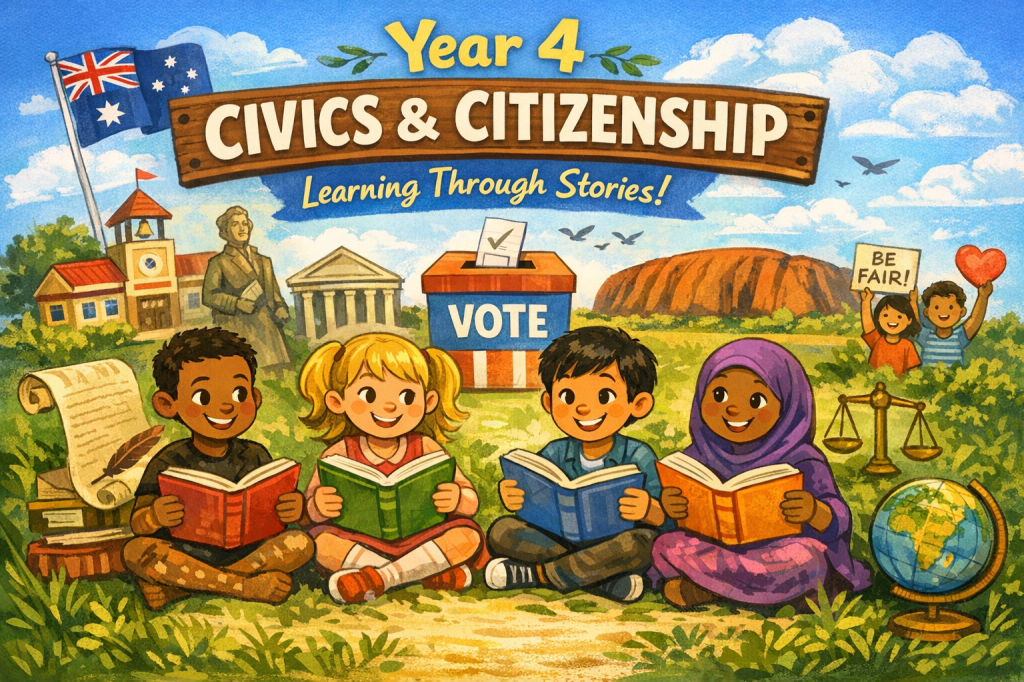
(AI Generated Image)
Hi parents and caregivers,
This term, our Year 4 students are exploring important HASS themes through picture books and fictional texts in our unit Stories That Shape Us: Exploring Civics and Citizenship. Stories are a wonderful tool for helping children understand complicated ideas. Students are gaining empathy, curiosity, and a greater comprehension of how individuals and communities influence the world around them through characters, situations, and significant topics (ACARA, 2026).
What Students Are Learning and Why it Matters
Students are using literature to grow their knowledge of geography, civics and citizenship, and history. Through stories, they investigate how people lived in the past, how communities make choices, and how people relate to their surroundings. These concepts are directly related to Year 4 curriculum descriptors like AC9HS4K01 and AC9HS4S03 (ACARA, 2026).
Students are developing their general capabilities, critical and creative thinking, ethical understanding, and intercultural knowledge through the HASS material. Books like Trina Saffioti’s Stolen Girl and John Marsden and Shaun Tan’s The Rabbits encourage students to consider other viewpoints and comprehend how stories can reflect historical events and cultural experiences (Marsden & Tan, 1998; Saffioti & Macdonald, 2011).
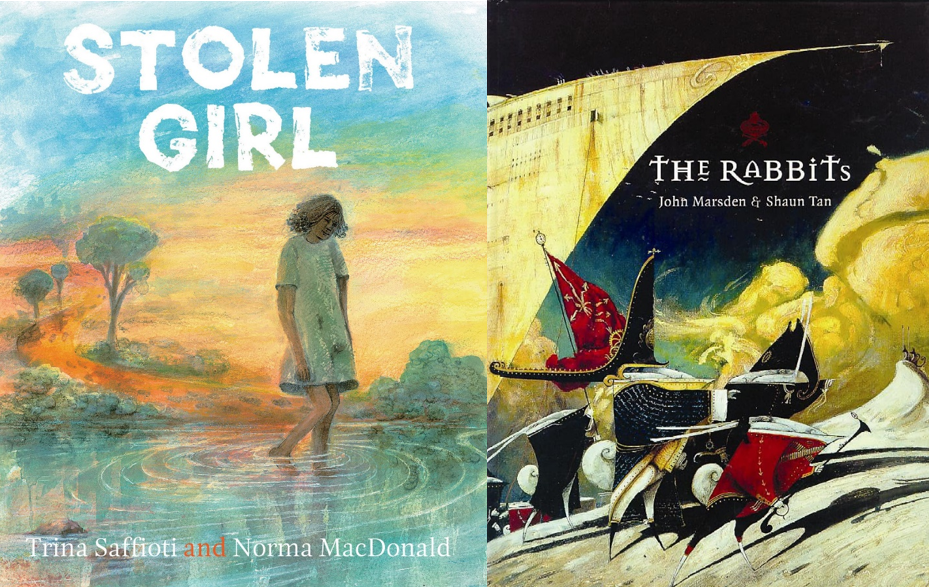
Children may emotionally relate to big topics through stories in ways that factual texts sometimes cannot. Learning through different perspectives teaches students about justice, accountability, and community. Additionally, picture books gives ideas like citizenship, sustainability, and belonging greater significance and accessibility for young students. Literature offers a secure environment for in-depth conversations on morals, making decisions, and how people affect the world (Heath, 2012).
How Students Are Learning
Students are engaging in activities such as:
- Reading aloud together
- Participating in guided conversations, and closely examining the decisions and motivations of the characters.
- Relating the themes of the stories to contemporary concerns like justice, patriotism, and civic duty.
- Communicating their understanding through creative activities, such as drama, art, writing, and mapping story settings.
- Comparing fictional events and historical facts.
How Parents and Carers Can Support
You might like to:
- Read picture books or novels together and talk about the subjects.
- Asking questions like “What would you do?” or “Was that fair?”
- Encouraging your child to check out HASS-related books from the library
Thank you for nurturing your child’s curiosity and imaginations. We look forward to seeing them grow more as citizens. Please reach out if you have any questions, we look forward to sharing more of your child’s learning throughout the term.
References
Blainey, G. (2014). A shorter history of Australia. Vintage Books, Published By Random House Australia Pty Ltd.
F-10 Curriculum | V9 Australian Curriculum. (2026). Australiancurriculum.edu.au. https://www.australiancurriculum.edu.au/f-10-curriculum/learning-areas/hass-f-6/year-4?view=quick&detailed-content-descriptions=0&hide-ccp=0&hide-gc=0&load-detailed-content-descriptions=null&side-by-side=1&strands-start-index=0
Heath, S. B. (2012). Words at work and play : three decades in family and community life. Cambridge University Press.
Marsden, J., & Tan, S. (1989). Rabbits. Rourke Publications.
Pascoe, B. (2019). Young dark emu: A truer history. Magabala Books.
Reynolds, H. (2021). Truth Telling: History sovereignty and the Uluru Statement. Newsouth Publishing.
Saffioti, T., & Macdonald, N. (2011). Stolen girl. Magabala Books.
Tilbury, D. (2011). Education for sustainable development: An expert review of processes and learning. UNESCO.
 Site Title
Leave a comment